



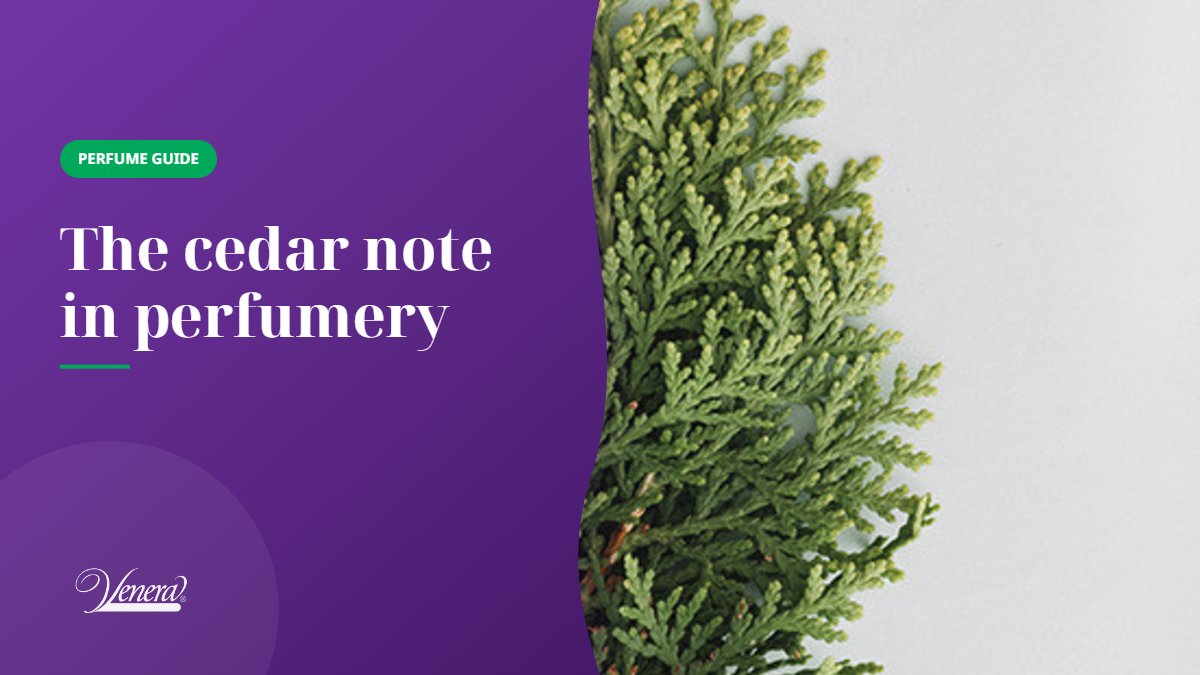
Learn more about the cedar note and its journey from nature to luxury designer perfumery
Cedarwood oil is one of the best-known and most frequently used notes in perfume fragrances. There can hardly be anyone who has touched the scent of cedar and remained indifferent: once we sense it, it is imprinted on our emotional pathways for good. It makes a strong impression and leaves the memory of itself for a long time.
Cedar (Cedrus) is a type of evergreen coniferous tree of the pine family that grows up to 30-40 metres. The cedarwood note actually comes to us from the Atlas Mountains in Morocco or the cedar forests of Virginia, USA.
Cedar has silvery-blue or greenish foliage: evergreen needles arranged in an open spiral on a long stalk. The branches spread wide, sometimes almost horizontally. The fruits of the cedar are cones, coloured in various shades of green, grey and brown.
The bark of the tree is thick, reddish to brown in colour and strongly aromatic. Cedarwood holds unique ingredients within it that contribute to the scent of woody and amber fragrances in perfumery.
As for cedarwood oil, a great deal could be said and written about it, and even that would probably not be enough. The oil is extracted from the foliage, sometimes from the roots, and from the wood itself. It is yellowish or brown in colour. A single touch to the senses is enough, and we are sure to be hypnotised by its scent for good. An interesting fact is that many oils classed as belonging to the cedar scent family are actually obtained by extracting the essences of juniper and cypress. For unknown reasons, natural cedar forests have almost disappeared today. The cedar is depicted on the national flag and coat of arms of Lebanon, because in ancient times there was a vast cedar forest there. The best-known one in Lebanon today, however, numbers only 375 trees.

The most widespread types of cedar are the Lebanon, Himalayan and Atlas cedar.
Lebanon cedar (Cedrus libani) is typical of the mountains of the Mediterranean region. Its crown is conical in the first years of growth and branches out over time. An interesting fact is that King Solomon used Lebanon cedar to build his temple in Jerusalem.
Himalayan cedar (Cedrus deodara) is recognised by its bright green to pale green tips. It reaches up to 45 metres in height, with a trunk diameter of up to 3 metres, and its branches grow horizontally.
Atlas cedar (Cedrus atlantica) is distinguished by its silvery-grey bark and blue-green needles.
But perhaps the most interesting thing is to trace the origins of the thousand-year history of cedar oil. It begins somewhere in the western Himalayas and the Mediterranean region. Essential cedar oil is in fact one of the oldest ingredients used in perfumery since ancient times. Suffice it to say that the ancient Sumerians used cedarwood oil as a base for paints, and the ancient Egyptians used it in their embalming practices. The image of the cedar tree is part of many myths and legends. It is no coincidence that the cedar is the most frequently mentioned tree in the Bible. The tree that covers the Holy Sepulchre is also a cedar. As already mentioned, Lebanon cedar was used to build the temple and palace of King Solomon. Papyri were also soaked in cedar oil to protect them from the ravages of time.
Where and for what is cedar oil used today? Mainly in aromatherapy, to balance energies, and to treat certain infections. Because of its intense scent, it is also used as a natural repellent for moths and other insects. The main use of cedar oil, however, remains in perfumery, thanks to the density and uniqueness of its aromatic properties.
In perfumery, cedar is a distinctive dark, deep, slightly spicy woody note; a warm, rich and intense scent shot through with sweet threads. Cedar oil gives uniqueness and refinement to any perfume. It is a dense, even and long-lasting note with an incredible velvety texture. It blends extremely well with citrus notes, as well as with the essences and essential oils of rose, bergamot, jasmine, orange, cypress and lavender.
Cedarwood oil is very often found as a base note in perfumes for men. The cedar essence enchants us and challenges the senses from the very beginning.
Some of the perfumes that contain cedar are:
Hermes Terre D'Hermes
D&G Light Blue EDT for Women
YSL La Nuit De L'Homme
Chopard Noble Cedar
Ferrari Cedar Essence EDP
Iceberg Eau de Iceberg Cedar
And what is your favourite perfume with a cedar note?